Insights from James Allen, Leader of Bain’s Global CEO Forum
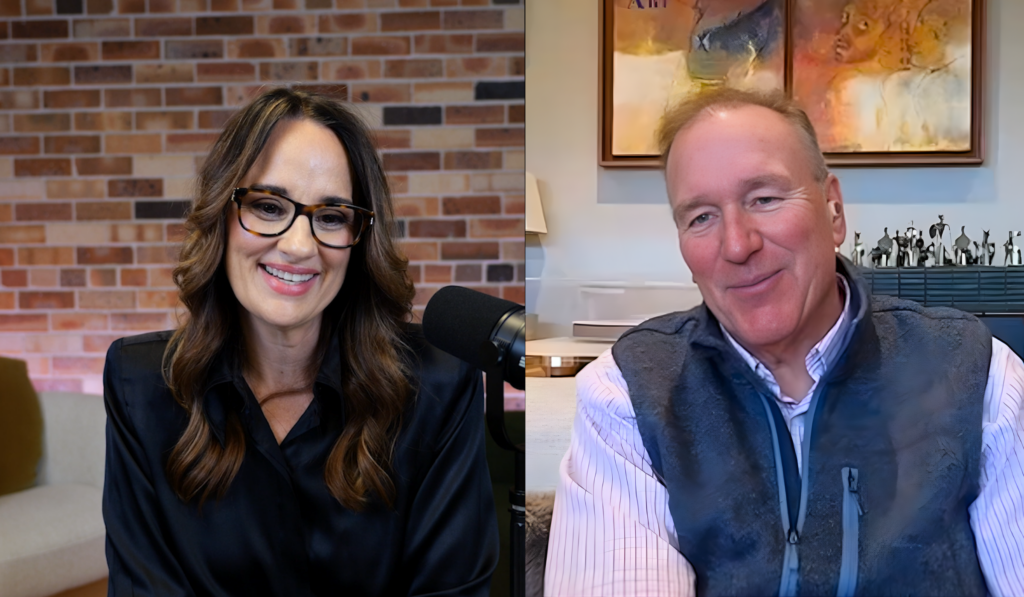
Recently, Vanessa Gavan sat down with James Allen, Leader of Bain’s Global CEO Forum and author of The Founder’s Mentality, for a conversation that brought clarity to a shift many leaders are quietly grappling with: the CEO role has fundamentally changed.
The conversation explores a set of defining leadership shifts: from pushing strategy to creating pull, from perfect planning to adaptability, and from structure to energy – highlighting the critical role of curiosity, sustainability, and simplicity in leading effectively in today’s environment. Here are the key takeaways:
The CEO role has shifted
The CEO role of the late eighties was largely analytical – focused on where to play, perfect anticipation, and long-term planning horizons. Today, the most effective CEOs have evolved from pushing strategy down through layers of management to creating pull, building a clear and compelling strategic narrative that captures the discretionary energy of the entire organisation, particularly those closest to the customer.
Adaptability over perfect anticipation
Planning is no longer about projecting the perfect base case and executing against it. In a world defined by uncertainty, the leader’s job is to build an organisation capable of responding well to change. Adaptability is not a nice-to-have, it is the strategy.
Become a student of energy
To drive entrepreneurship and frontline responsiveness, leaders must become highly attuned to energy: their own, their team’s, and the organisation’s. Bureaucracy often becomes a system of energy drains, where structures and individuals unintentionally slow momentum. Even high performers can act as energy vampires. The role of the CEO is to build a leadership team that consistently generates energy and to remove friction wherever it exists.
Curiosity as a leadership discipline
Thriving leaders continually ask how to maintain a curious organisation – one that looks outward, challenges assumptions, and stays ahead of change. Curiosity is not an inherent trait reserved for a few; it is a discipline that must be intentionally developed and modelled from the top. It is a critical driver of learning speed, adaptability, and better decision-making.
The myth of chapters
Many leaders operate under the belief that balance, sustainability, and personal fulfilment belong to a future “chapter.” This is a dangerous assumption. Sustainable leadership must be lived in the present. Two simple acid tests help cut through this: whether weekends are spent recovering for Monday or pursuing meaningful interests, and whether you are fitter – physically and mentally – at the end of each week. These indicators reveal whether your current pace is sustainable or gradually eroding your effectiveness.
Exhausted leaders complicate, energised leaders simplify
A leader’s primary responsibility is to simplify. To make the work clearer, more direct, and more purposeful for their people. When leaders are exhausted, they tend to overcomplicate, introducing friction rather than removing it. Energy is not abstract – it is the foundation of clarity, simplicity, and performance.
The leaders who will create the most value in the years ahead will be the ones who have built organisations with the energy, curiosity and adaptability to thrive in a world that won’t slow down.
At Maximus, this is the work we do every day – shaping leaders who create lasting value for their organisations, their people and the communities they serve.